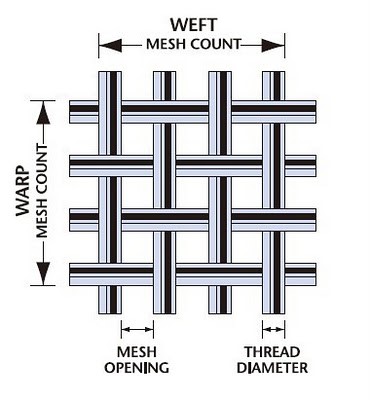
As already stated, a screen is a rectangular frame with a mesh fabric tightly stretched across it and glued or mechanically held in place.
This mesh is tightly stretched at an even tension.
Note: At any stage during processing, a mesh can become damaged, thus requiring a restretch - see Dealing with splits
Different mesh counts are used for different applications.
In simple terms, the mesh count is the number of threads per linear centimetre used to weave the mesh.
The following is a magnified image of a typical screen mesh, representing a 10 mesh count.
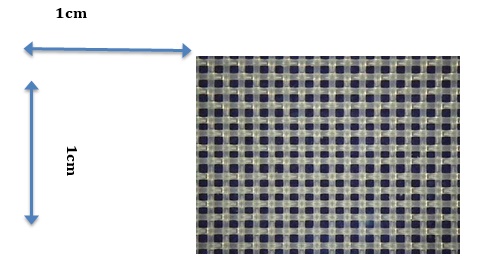
Note: Illustration is not to scale
As a general rule, higher mesh counts allow for finer detail lower ink deposit while lower mesh counts are used when there is less detail and a higher ink deposit is required.
Mesh counts are available with different thread diameters. A thinner thread wil result in a larger aperture or mesh opening for the same mesh count.
Threads are measured in microns (one-thousandth of a millimetre, 0.001mm)
The thickness of the thread used at TOT is standardized as follows:
|
10mesh |
= |
260 microns |
|
24 mesh |
= |
140 microns |
|
34 mesh |
= |
100 microns |
|
49 mesh |
= |
55 microns |
|
62 mesh |
= |
64 microns |
|
90 mesh |
= |
48 microns |
|
120 mesh |
= |
34 microns |
|
120L mesh |
= |
31 microns |
Mesh is available in various colours, most commonly white and yellow. Yellow mesh is more desirable as it reduces light refraction when exposing.
The tension (that is, how tightly a mesh is stretched) is measured in Newtons.
A tight screen will perform better than a loose screen.
Tensions relax with use.
Fixed frame mesh is stretched at approximately 20 Newtons as any tighter will result in mesh failure, i.e. splits.
Tension can be measured with the aid of a Newton meter.
Printability of fine detail, lines and halftones
The resolution of edges in the design
Ink release properties
Printing speed in relation to your ink viscosity
Ink volume thickness
Ink flow and consumption during printing
Exposure times for screens will vary depending on the mesh count. A finer mesh screen will expose faster than a lower mesh screen, thus requiring a shorter exposure time.
Related Topics
Understanding the Life-cycle of a Screen